One way the Wycliffe Global Alliance can encourage collaboration in the Bible translation movement is to set tables—in other words, to facilitate needed discussions with the right people and organisations present.
In the Alliance’s Americas area, this is happening in 12 different countries with gatherings called national Bible translation tables. Leaders of all ministries contributing to the movement in a particular country are meeting in friendship, collaboration and prayer.
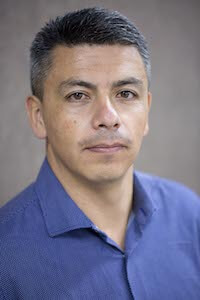
“It is ministry leaders in a country, serving in Bible translation and Scripture use, with a vision of communities being transformed by the Word of God,” says David Cardenas, the Alliance Americas Area Director, who is based in Bogota, Colombia. “We learn how to develop Bible translation models in collaboration, facilitate church involvement, strengthen friendship among leaders, foster biblical generosity, and more. What we want to see in Bible translation, collaboration, is happening at these tables, or will happen at the tables.
“A table is a community—a place of having fellowship and conncection, one to another,” he adds. “It’s like a town square where different voices from different cultural, denominational, and organisational backgrounds can be heard and consider serving together. It’s a place where new friendships, new possibilities are flourishing.”
While tables currently exist within 12 individual countries, it doesn’t take much imagination to envision the idea expanding regionally and even globally. On 9 June, a virtual gathering is planned for the national facilitation teams of the 12 tables. This meeting will facilitate discovery and discussion of common issues. One is when countries like Colombia and Panama share a border and the same people group lives on both sides. These conversations can save translation teams from duplicating efforts.
“This is the kind of collaboration we have envisioned,” David says. “Sharing experience, sharing resources. This is what we want to see between countries.”

An Inclusive Conversation
“One thing we found was that all countries in Latin America have a Bible translation history,” David says. “And there is Bible translation progress happening in most of the countries today. So we had a lot of ministries doing work, but with not much dialogue or collaboration.”
In most of those countries, there is at least one Alliance organisation, plus Bible Societies, indigenous networks, church denominations and international ministries—all doing Bible translation in some way. Sometimes work was being duplicated. Other times there could be an undercurrent of competition, David says. Some groups felt left out of the conversation altogether.
“We also found that we have indigenous organisations and churches waiting to participate in Bible translation,” he says, “but they were not considered in the decision-making processes. So we have indigenous churches and networks, but not being part of something bigger.”
Years ago, it might have seemed impossible to see people from more than a dozen different ministries at the same table, collaborating in Bible translation. Leaders realise God is unifying a movement, in settings where all voices carry equal weight.
“The new voices should be heard,” David says. “The indigenous churches need to be heard. The louder voices need to listen to the smaller voices. So the tables are places of polyphony. It is a place of polycentricity because each table is making decisions for the movement.”
Table Basics
Once the first table was established in Brazil with the support of AMTB, the Americas Area leadership team helped to establish the table in Colombia that same year. Americas. In 2019, tables started in Guatemala, Mexico, Venezuela and Peru. After the pandemic arrived in 2020, tables met virtually in Bolivia, and then 2021 saw the addition of El Salvador, Ecuador, Panama, Nicaragua and the Dominican Republic. Today, more than 160 leaders from more than 140 ministries participate in these 12 national tables.
Driving principles identified in these tables are:
- Friendship
- Unity
- Dialogue
- Collaboration
- Diversity
- Respect
- No duplication
- No competition
- Generosity
- Trust.
“So those are the 10 key values that the participants are committed to respecting and behaving with honour to one another in that table,” David says.
As a table meets and grows, a common culture and mission emerges. Purposes identified include updating and sharing information; completing the pending task; influencing the use of the Scriptures; strengthening friendship, unity and collaboration; easing participation of the church; and encouraging biblical generosity.
That first item, updating and sharing information, has proven immensely valuable. National or international organisations may have their own data, but not everyone at the table has had access to that—and it isn’t always accurate. When everyone can contribute and share the same data, better decisions can be made about priorities and urgency within the country.
“For example, in Colombia, we have 11 new research activities to confirm if groups need or don’t need Bible translation,” David says. “This is because the table is taking collaborative action about what they consider is needed in Colombia and how we can solve this, how we can do better.”
Another reason tables have been working is that they create a “third space.” When representatives from different organisations interact, their cultural contexts, languages and familiar environments can conflict. A third space provides in-between, neutral ground where people can work together. During the pandemic, Zoom has provided a third space. For live gatherings, attention is paid to choosing a setting where everyone is on equal footing.
Assembling a Table
National tables have started small, usually with an Alliance organisation playing a central role, with help from the area leadership team, in deciding whom to initially invite. Typically it’s a group of five or six people to start. In Latin America, the COMIBAM mission network and national Bible Societies are normally represented. Church denominations usually come soon thereafter and are high priority; if they are already Alliance organisations they are included from the beginning.
“It is important to discern the collaboration environment in a country,” David says. “In some countries in Latin America, collaboration is something good. In others, competition and duplication are part of the culture. So how do you challenge that culture? … And for that, the alliance has been very key, because the Alliance is something trustworthy and positive for many. The Alliance is a community, so when we are sure what the Alliance is and the kind of mission we have, this is most trusted for the organisations.”
Then, as initial meetings happen and more organisations and leaders are identified, the Alliance’s role moves to the background, more as influencer than convener. One important way this happens is by holding third-space retreats.
“They have been so special to connect people, because normally we connect with one another for business—what we have to do,” David says. “But when friendship comes before doing business, the quality of collaboration will be more special. This is the kind of environment we have in Colombia, in Brazil, in El Salvador and Guatemala. We as an alliance have facilitated those retreats. One day, two days, having a spiritual agenda, but key topics to discuss together … The kind of friendship that is being built is so special.”
The most recent table retreat was in February, for the Colombia table. Eighteen organisations were represented. “So it’s interesting how we started with six, and now we are 18 organisations,” David says, “but those 18 are working together making decisions for Colombia, for the advance of Bible translation.
“In some countries where the table is advancing, they are taking ownership of the process. That is a good indicator, that they recognize that this is so important for them.”
Table participants quickly realise the value of the unique experience. Most have not seen this type of networking before in Bible translation.
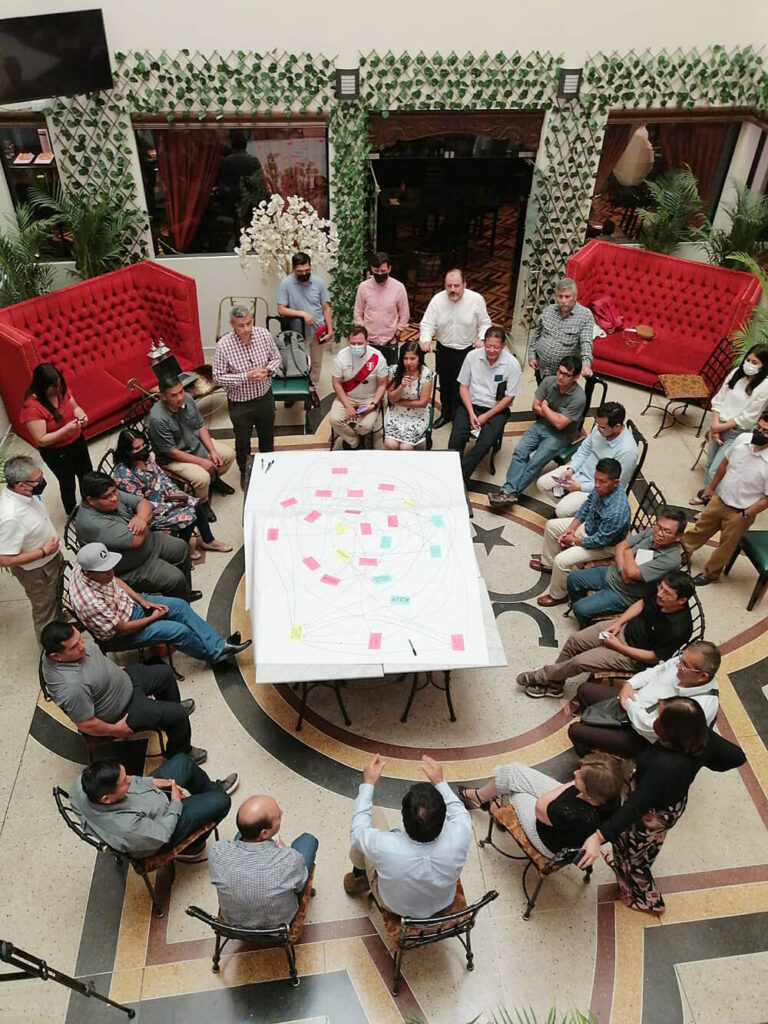
“We do an activity called mapping your network,” David says. “They can realise what kind of relations they have one to another. They realise the others are doing a good job and they feel encouraged that they are sitting and talking with them. They realise what is happening and what is not happening, so they say ‘OK, let’s go with that third space about Bible translation and continue.’”
“To support the roundtable system, we recently formed a peripheral team of nine influential leaders in Latin America who represent various regional organizations, while also participating in their country’s roundtable. This group’s mission is to care for values and purposes, such as accompanying each table in its development.”
A Global Vision
David hopes the tables developing in the Americas serve as a model of collaboration—bringing leaders and organisations and denominations together for conversation, prayer and planning around Bible translation.
“Because normally what I see is that in other countries there is one Alliance organisation per country,” he says. “And in that moment, much of the power and information and knowledge belongs to that Alliance organisation. But if they want to build a community with more participation, with more generosity, more organisations, maybe the table can be a model to take and experience. They can experience a third-space concept, so they can bring others and have common conversation and a common agenda.
“And of course the Alliance organisation plays a key role, but it can also inspire other organisations to see Bible translation is something that belongs to everybody in the body of Christ. So this is something that they can watch and follow and experience.”
—
Story: Jim Killam, Wycliffe Global Alliance
Alliance organisations may download and use the images from this article.